Gaudet is awarded a Teaching Fellowship at the University of Texas at Austin

Gaudet was awarded a Raymond Dickson Centennial Endowed Teaching Fellowship “in recognition of exemplary performance and commitment to teaching.” This award is through the University of Texas at Austin and the College of Liberal Arts.

At UT-Austin, Gaudet teaches an upper-level undergraduate course, “Biological Clocks and Behavior,” and a graduate course titled “Neuroinflammation in Health and Pathology.” Gaudet is honoured to receive this award. He is thankful for extensive training in teaching from coursework and mentors at the University of British Columbia, and for the support of colleagues and teaching experts at UT-Austin and in the Department of Psychology.

New paper: Aging and miR-155 affect survival and neuropathic pain after spinal cord injury

We published a new paper in Brain, Behavior, and Immunity!

Aging and miR-155 in mice influence survival and neuropathic pain after spinal cord injury.

Fig 1 survival copy.jpg

The average age at spinal cord injury is increasing, and people are living longer with improved treatment after spinal cord injury - yet there remain important questions about how spinal cord injury affects the geriatric population. How does age at SCI affect pain symptoms? Can pain symptoms after SCI be quenched using strategies that reduce inflammation?

In this paper, we assessed spontaneous pain symptoms and evoked pain in adult and aged mice. We also sought to reduce pain symptoms by using mice lacking a key pro-inflammatory microRNA, miR-155. Aged mice showed increased spontaneous pain symptoms and death after injury, which were dampened in mice lacking miR-155.

 
Fig 2 HG - VF copy.jpg

At baseline, aged mice had increased heat hypersensitivity. After SCI, both adult and aged mice displayed pain symptoms, which were partially alleviated by miR-155 deletion.

These results highlight the importance of studying SCI and neurologic disorders across the lifespan. Identifying age-related deficits and immunomodulatory treatments after SCI could help improve clinical approaches for pain management.

For more, see our related Twitter thread.

Virtually tour the G-Lab and campus!

Littlefield Fountain - Main Building.jpg

Wonder what it’s like on campus at University of Texas at Austin? What’s a campus without a turtle pond, a world-class art gallery, or a canoe sculpture? UT has it all! Our lab made a video - check it out here.

For the research inclined, we also made a tour of the Gaudet lab. The Health Discovery Building was completed in 2017 and features open-concept research areas and beautiful open spaces for lunch and meetings. Check out our video here.

Special thanks to G-Lab members Sydney, Emily, and Kate for helping with the video, and to Emily Greenough for producing these edits!

Covid-19 vaccine is coming to Austin!

The Covid-19 vaccine administration setup was just completed in our building at UT-Austin’s Dell Medical School! Health care workers have had a difficult year, so it is exciting to see this development - particularly before the holidays. Thank you to all essential workers.

We’re looking forward to widespread administration of these remarkably effective vaccines after extraordinarily speedy creation and testing. Go Science!

vaccine setup.jpg

Andrew "visits" University of Kentucky

2020-09 UK visit screenshot.jpg

Andrew was invited by Meifan (Amy) Chen to visit and present Gaudet Lab work at the University of Kentucky on September 28th. Andrew had a great time meeting with other neuroscientists, SCI researchers, and chronobiologists at UK. Kentucky researchers asked some tough questions and are doing top-notch research! We’re looking forward to seeing our UK colleagues in person again at post-pandemic conferences.

The Gaudet Lab welcomes its first graduate student!

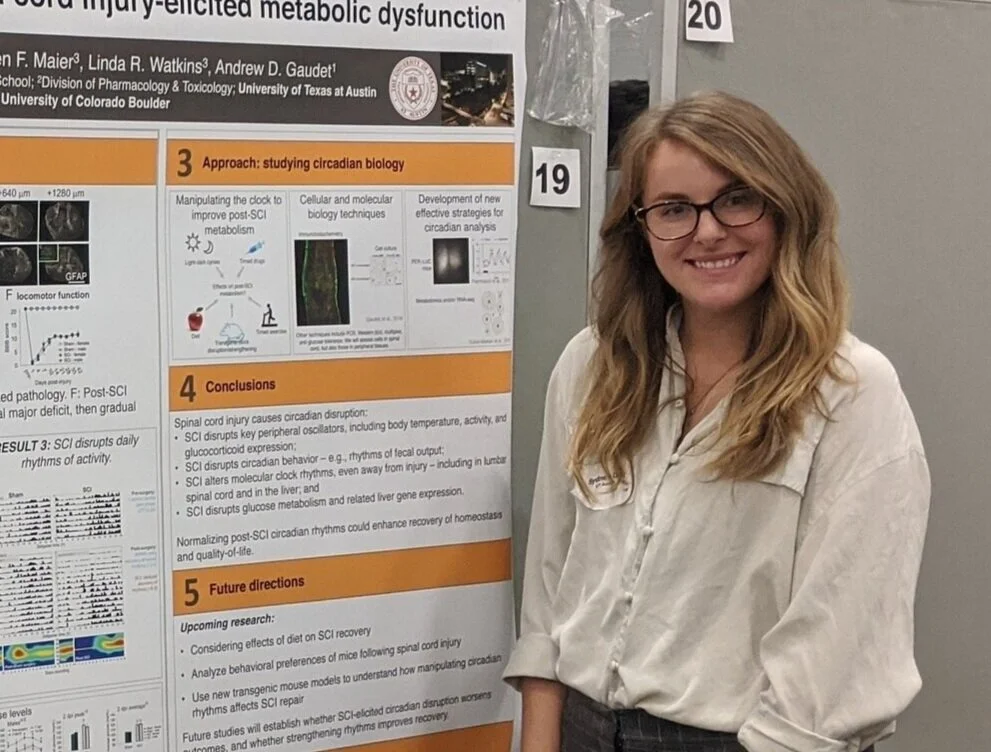
Sydney Lee presenting data at the 2019 Mission Connect meeting in Houston, TX.

Sydney Lee presenting data at the 2019 Mission Connect meeting in Houston, TX.

We are delighted to welcome our first graduate student! Sydney Lee has been working with us as a Research Technician, and aims to complete her PhD in the lab. She has already made remarkable progress on several projects. First, she is using a new thermal preference approach to decipher the relative salience of anxiety vs. pain. Second, she is exploring new approaches to improving repair after spinal cord injury. Welcome, Sydney! Wishing you good research karma on the journey to your PhD.

Visiting UT's Health Discovery Building today was exciting!

Andrew visited his office at the Health Discovery Building today! It was an exciting change of pace and break from life around the neighbourhood. Hopefully, the phased reopening at University of Texas at Austin and the Dell Medical School will enable effective research, while maintaining safe and healthy staff, faculty, and students.

View from the Health Discovery Building of Waller Creek and Dell Seton Medical Center.

View from the Health Discovery Building of Waller Creek and Dell Seton Medical Center.

Andrew presents neuroinflammation and circadian research at the Online Spinal Cord Injury Seminar Series.

2020-05 Gaudet SCI seminar series picture.jpg

Andrew was honoured to present an overview of work from his postdocs at Ohio State and CU-Boulder, and from his new lab at University of Texas at Austin. He discussed the role of miR-155 in driving neuroinflammation, functional deficits, and pain after SCI. He showed new data using the TIDAL test for relative salience of pain vs. anxiety. Finally, he discussed how SCI may disturb circadian clocks - and how chronotherapies could help improve metabolic and neurologic recovery. Thanks so much to Warren Alilain for organizing this superb online series!

Gaudet Lab participates in the Wings for Life World Run!

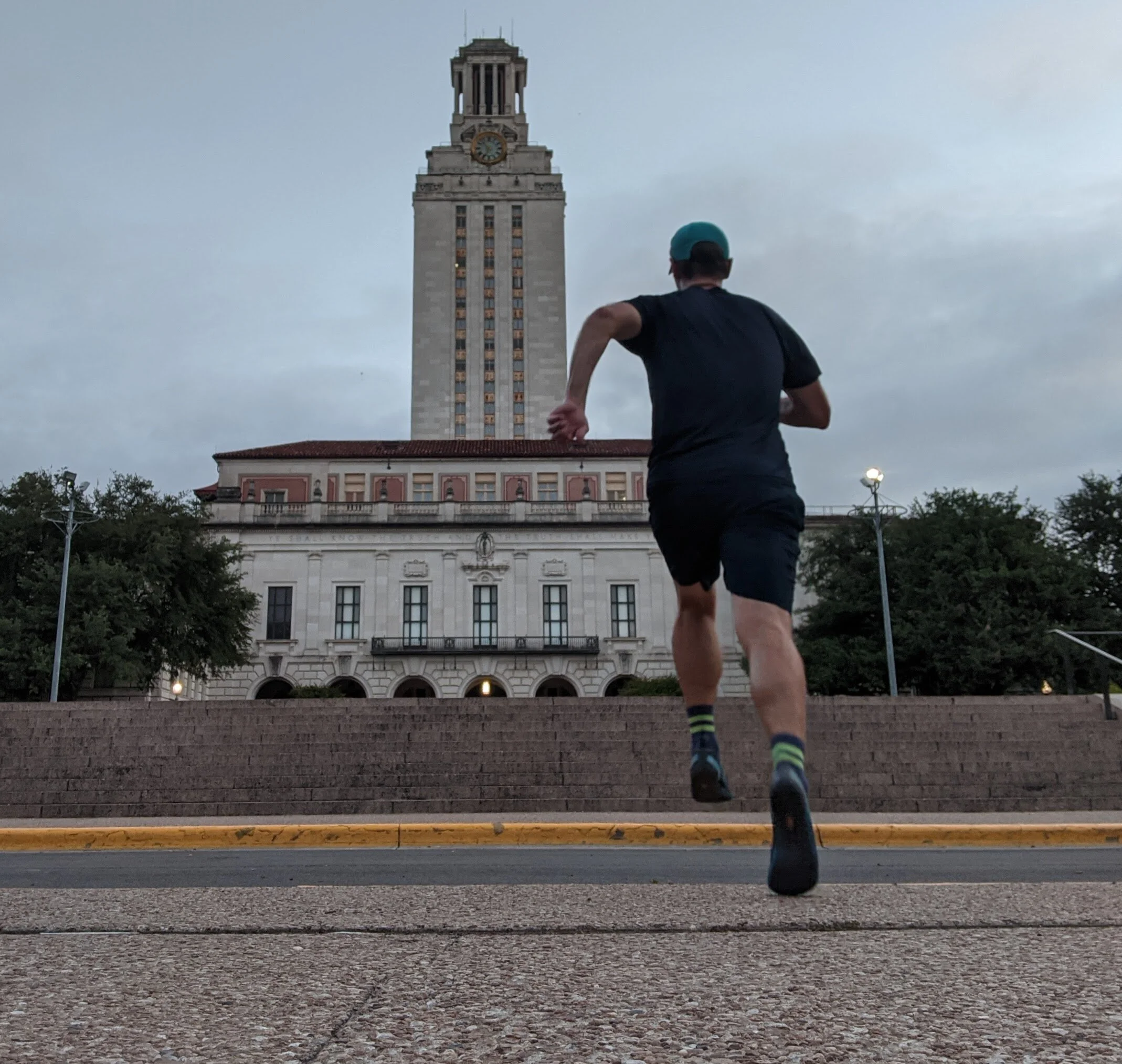
Wings for Life Foundation supports the Gaudet Lab! We were excited to have the opportunity to give back. Andrew ran in Wings for Life’s fundraiser, the World Run. This occurred at the same time across the world - which was 6 am here in Austin! Over 77,000 runners participated across the globe. Andrew ran from home to campus at UT-Austin to compile photo evidence :) Thanks for your support, Wings for Life!

IMG_20200503_065328_3.jpg

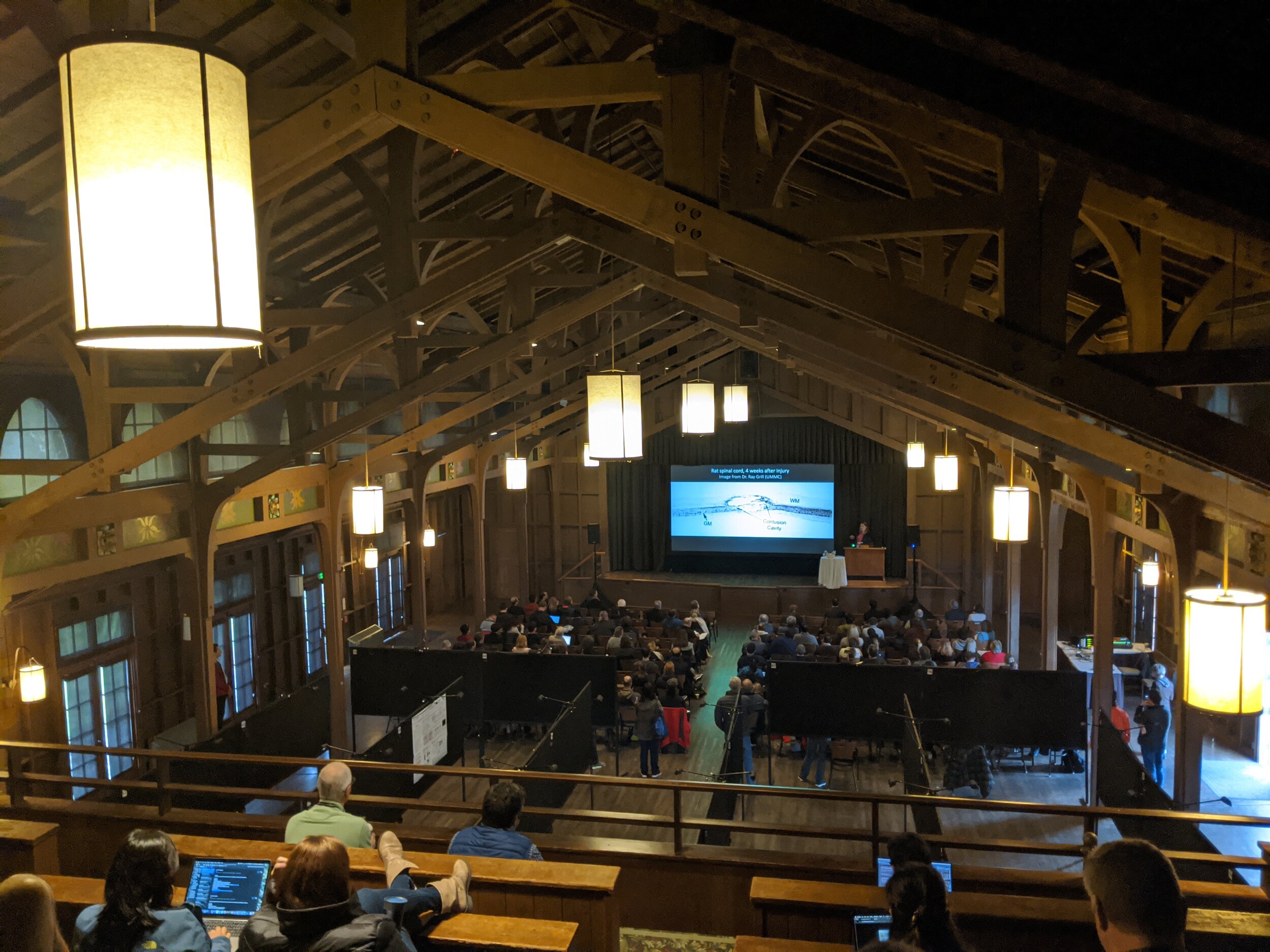
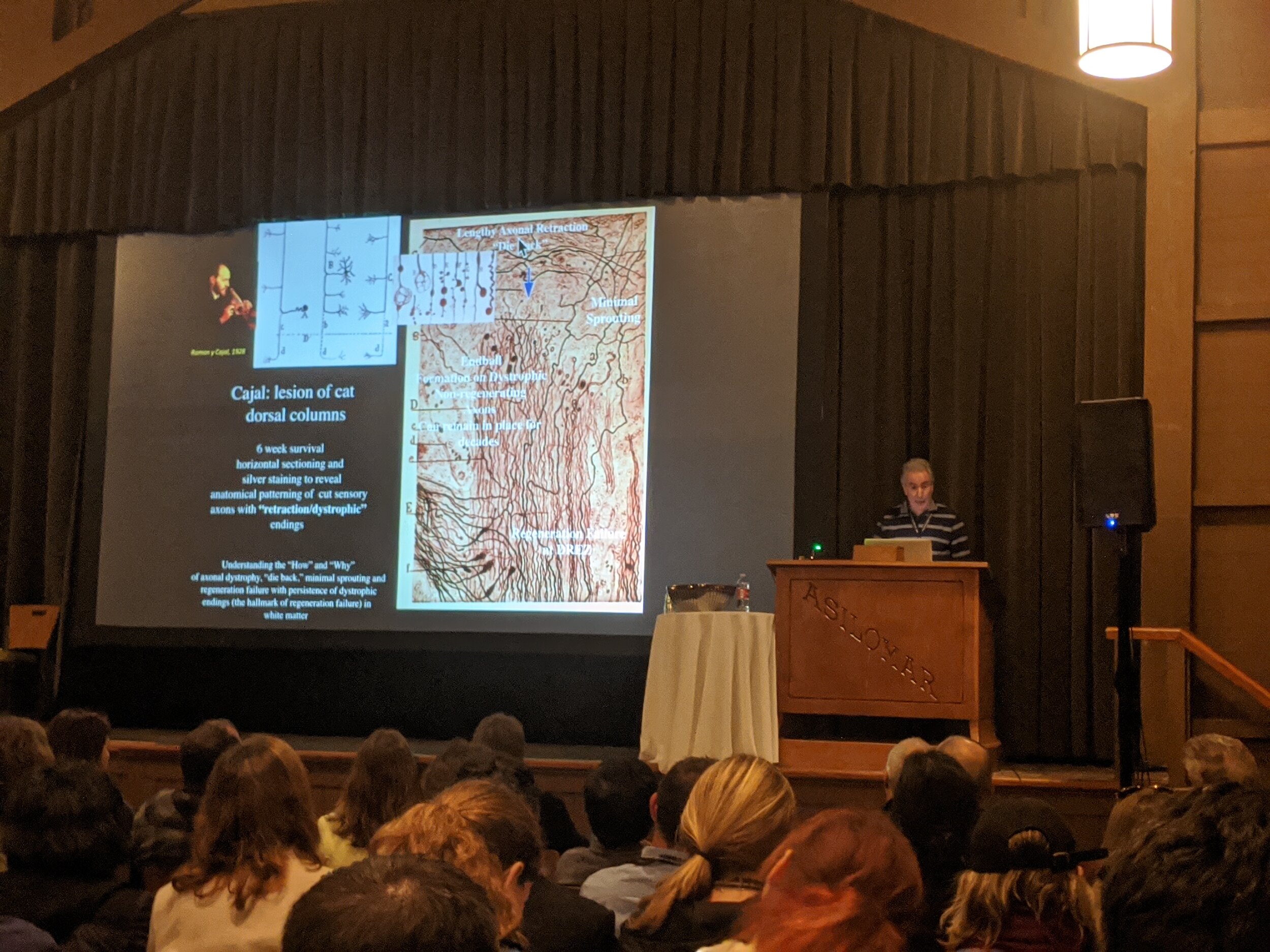
International Symposium for Neural Regeneration: Asilomar 2020

The Gaudet Lab showed up at Asilomar this year. Andrew presented new work compiled by Sydney Lee and our team, which is delineating the relative salience of pain vs. anxiety using a thermal preference apparatus. The data also show that spinal cord injury may modulate the relative salience of pain and anxiety.

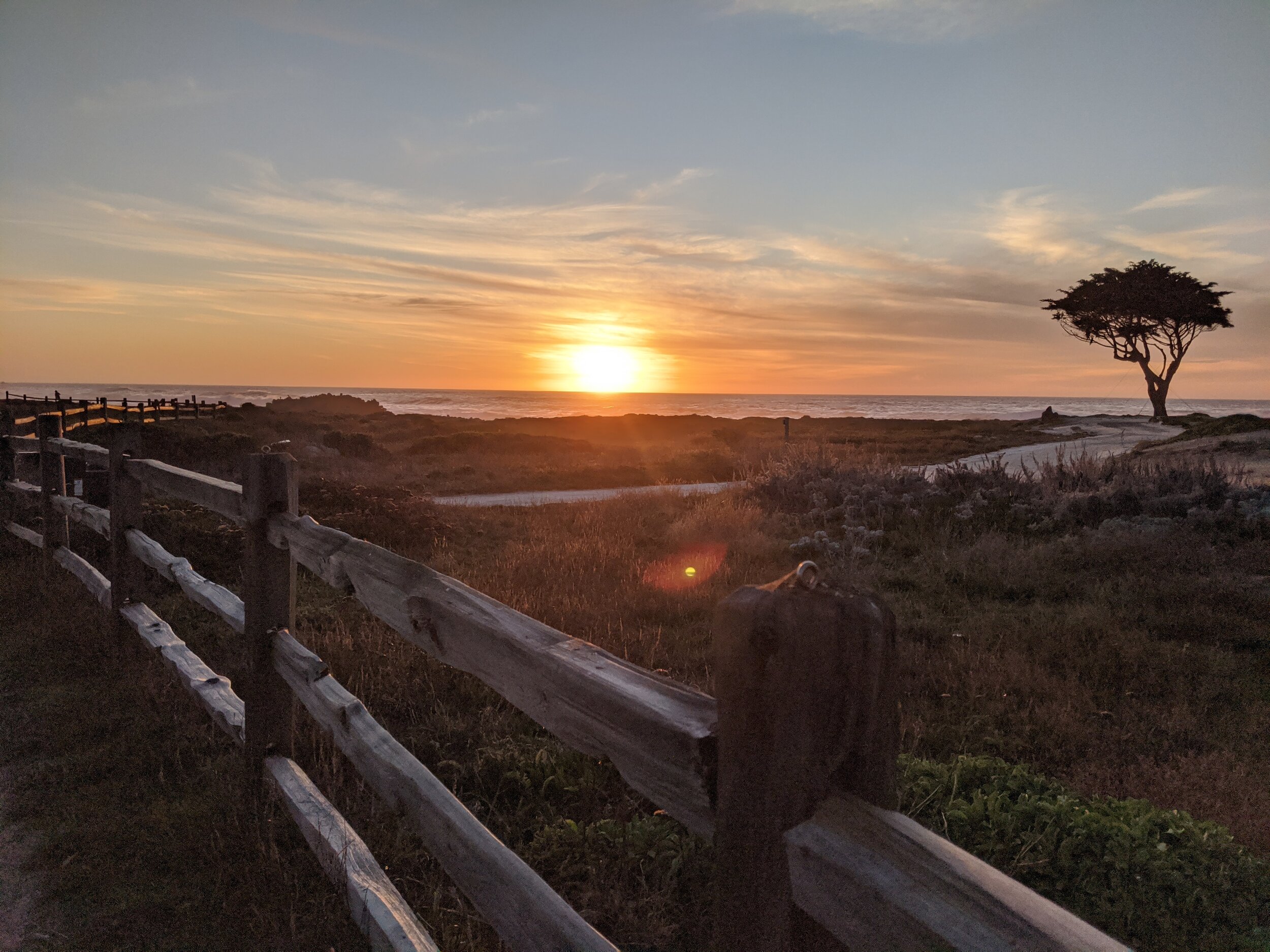
As always, there were many highlights of this intimate meeting by the beach! There was the debate between Jerry Silver and Michael Sofroniew. There were compelling talks by the likes of Veronica Tom, Jen Dulin, and David Magnuson. There was the superb socializing with friends old and new. There were the daily post-conference meet-ups in small cabins on the campus. And there were sunset runs by the beach! It was certainly a worthwhile meeting. See you in 2022.

Gaudet Lab presents at Mission Connect spinal cord injury meeting in Houston.

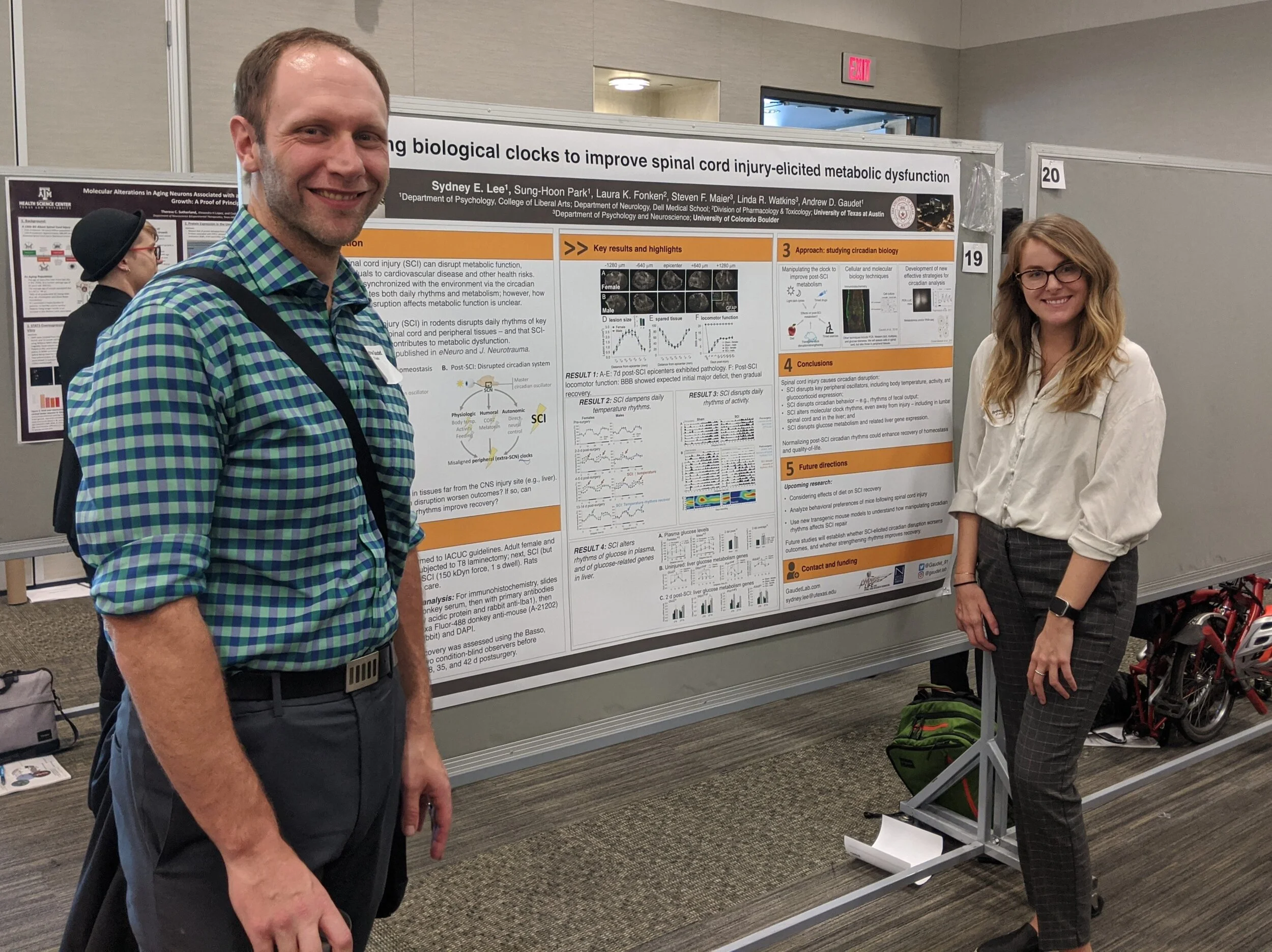
The Gaudet Lab attended the Mission Connect meeting in Houston. Sydney Lee and Sung-Hoon Park from the lab presented posters. Michael Sofroniew delivered the plenary lecture, and we had the opportunity to discuss SCI Science with colleagues from Texas and beyond. We’re looking forward to attending the International Symposium on Neural Regeneration in Asilomar, CA in January!

Andrew Gaudet and Sydney Lee at the poster session.

Andrew Gaudet and Sydney Lee at the poster session.

Supporting undergraduate achievement at UT-Austin: a challenging road to success for Iraqi refugee Qusay.

There is a great privilege and responsibility afforded to professors - they are in a position to help people achieve their career and life goals.

In November 2018, Andrew joined the UTeam program - a College of Liberal Arts (COLA) program designed to create community between professors and undergrads from under-served populations. Andrew was matched with Qusay Hussein. Qusay has a remarkable backstory, which includes surviving a bomb attack; surviving and achieving despite challenges with being blind; and arriving in the U.S. without speaking English. He is an extraordinary example of resilience and persistent positivity.

Andrew met with Qusay, and helped him find a lab/professor match in UT’s Department of Psychology. Qusay hopes to complete a Ph.D. in positive or motivational psychology.

For more, please read the story in the Department of Psychology’s Spring newsletter.